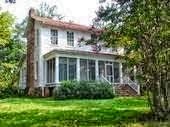
Wednesday, May 27, 2015

Will we be a National Historic Landmark?

Context: Part One

Andalusia Farm was the context for some of the best fiction writing of the 20th century. The farm’s historical significance is currently being reviewed by the National Park Service for potential National Historic Landmark Designation (NHL).

I spent two days recently with Evelyn Causey and Fielding Link. They were conducting field work at Andalusia as part of the NHL review by the National Park Service, the agency that administers the National Historic Landmark program. Andalusia Farm is already on the National Register of Historic Places but a National Historic Landmark? That is exciting! We likely won’t know for sure until next spring. It is a lengthy process of research and case-making on the degree of the farm’s national importance.

Lyn, Fielding and I tromped around the property for hours armed with maps, aerial views, cameras, and GPS recorders. We saw vestigial roads, frayed planting terraces, deer tracks, turkey and bobcat prints, and plenty of old fence lines. It wasn’t hard for us to imagine the field where Mrs. May has her fateful and fatal encounter with the wayward bull.

We also spent considerable time in and around the historic structures on the farm. We climbed up into the Cow Barn hayloft and it was easy to conjure the tryst-that-didn’t-end-well between Joy/Hulga and Manley Pointer. From that vantage point we looked out on the farm and could easily imagine the comings and goings of the farm folks who silently conspired murder in “The Displaced Person.”

Flannery’s letters also document so much of the farm context in which she wrote. Historic photographs and oral histories add to that record to help researchers understand what the farm looked like during the period of significance. That’s “preservation-speak” for the period of time the property gained its significance as a historic resource. In other words: 1951 to 1964, when Flannery lived and wrote here.

Sure the farm has other stories to tell. The property was a planation in the 19th century and later was a weekend retreat for Flannery’s uncle, Bernard McHugh Cline, who purchased the property in the early 1930s and whose large extended family enjoyed outings at the farm. There is also the story of the whole farm enterprise—later co-owned and grown by Louis Cline and his sister Regina Cline O’Connor—and the scale, economics, and the challenges of a middle-aged widow primarily responsible for managing people, property, and equipment at mid-century, while also supporting her artist daughter.

But Andalusia’s significance is primarily connected to Flannery O’Connor’s residence and creative output here between 1951 and 1964. The Flannery O’Connor-Andalusia Foundation is dedicated to preserving that context. Andalusia’s first Executive Director, Craig Amason, can be credited with the hard work of bringing the Hill House and Cow Barn back to life. He raised the funds and administered those capital projects−a heroic task with limited resources. Those buildings are now open to the public and extend the visitor experience on site. We want to continue to responsibly care for the remaining historic structures so we preserve as much context as possible.

We are fortunate to have received funding to rebuild the Equipment Shed. Thank you Watson-Brown Foundation Junior Board and our wonderful anonymous donor! That project is almost complete and soon visitors can see the center for repair and reuse at the farm. The well-used work tables, the room where horse tack was kept, and the farm’s vintage tractor and wagon all evoke the period of significance.

As Lyn and Fielding and I walked around the shed it was easy to imagine the paranoia and whispering in unseen corners that course through “The Displaced Person.” The shed will also provide what is perhaps our largest gathering space; a beautiful sheltered spot overlooking woods for programs (films, lectures, workshops, etc.) that can likely accommodate 100 or more.

Programming is necessary for any historic site and using structures for engagement ensures the farm is loved and supported. After all, a static shrine will quickly wither and fade if visitors don’t engage more deeply than passively looking. Engagement and relevance are critical as we compete for leisure time and combat a growing disinterest in history and literature. With each rebuild we must design-in ways to encourage people to visit the site, to learn something, to (re)read Flannery’s writing, and to come back and bring friends and relatives.

Repeat visitation is the lifeblood of every historic site, historic house, and every museum, aquarium, zoo, and botanic garden. With each structure brought back online we encourage repeat visitation. Next up for rescue? The Horse Barn, a threatened structure that is seriously leaning and rapidly deteriorating. The structure is in clear view from the Main House porch and Flannery’s room, the one she painted on canvas, and the one where various equine creatures (horses and ponies, donkeys, burros and hennies) lived during her time at the farm.

One-by-one we are caring for structures before it’s too late. Of course, the Main House is on the list as is the small Calf Barn and remaining tenant house on the edge of the front pasture as well as the “Nail House” a collapsed structure to which Flannery’s bird run was attached. For us it is all about context and the period of significance while also acknowledging our own 21st century context and the realities faced by all historic sites.

Stay tuned for the next post Context: Part Two as I discuss the context for historic sites and house museums worldwide and the ways in which Andalusia staff are participating in industry-shaping, leading edge practices.

-- Elizabeth Wylie, Executive Director, The Flannery O'Connor-Andalusia Foundation

Evelyn Causey and Fielding Link

Saturday, May 9, 2015

Apertures: Andalusia*

For Flannery O’Connor

Each day the eye finds fresh fare,
filling the homely bowl
of routine with slivers of light
and shade so that even the cracks
in the plaster are crooked roads
to somewhere:
A car shudders up
the dusty drive, cadenced
voices pass the time of day
in the familiar dance,
gauging their moves, a bow,
a do-si-do around the corners
of the room, as glasses perspire
onto the tabletop, a door shuts.
A boy or a man or just a figure
in the distance climbs
onto the sloping back
of a mule. Somebody brings
news that won’t wait the telling,
that doesn’t bear repeating
but will be repeated,
somebody’s mouth a long O,
agape, agape, a love feast.
The bloody sun burns low
enough to set the woods on fire,
one arm grazes another
that doesn’t want to be touched.
A plate of slightly rotting fruit
rests on the dining room table,
ink-smeared fingers endlessly
turn the pages of the newspaper
or carefully place the rosary
in the bureau drawer.
A former tenant visits,
he doesn’t want to leave,
he stands for a long time
in the middle of the yard
running his fingers through            
his greasy hair, clearing                   
his throat, repeating himself.
The tops of trees are silvered
by an antique light.
For a moment a peafowl
stands on one leg
on the roof of the barn,
a live weather vane,
another fans himself
in the front yard.
Nobody notices.
A window slams shut.
The hired man’s children
in the back of the car
swat each other with comic books.
Is that smoke on the horizon,
do you smell it, no, well then.
A meal is served, nobody speaks.
Outside, it’s early evening,
the bats lilt through the air
as though they are beautiful.
They are small black doors
into the dark.
 

-- Sarah Gordon, founding editor of the Flannery O'Connor Review, is the author of Flannery O'Connor: The Obedient Imagination and A Literary Guide to Flannery O'Connor's Georgia. Gordon organized Georgia College and State University's extensive collection O'Connor manuscripts. *This poem won the Ron Rash Poetry Prize sponsored by Broad River Review in 2010 and was published in the journal that year. It has also appeared in Georgia Poetry (Texas Review Press 2013) and is forthcoming in Georgia Poetry (Negative Capability Press 2015).

Friday, April 10, 2015

On Hometown Fame

Within the past couple of years, I have had to begin convincing those that I meet that my hometown actually exists—something folks are generally not prepared to do. Woodbury, GA, has experienced its own little fifteen minutes of fame in recent years through its being featured on cable television’s The Walking Dead, a show largely dedicated to showing the numerous possibilities and permutations of dismemberment. Dismemberment tends not to be a terrible drawback to the titular “biters,” as the fictional Woodburites call them; we’re not going after realism in watching a show about zombies, after all. Further, the show keeps its viewers perpetually on the brink of an emotional crisis from week to week as their favorite characters are perpetually at death’s door, be it from the zombies, unfortunate choice of traveling companion, or some other misfortune. (If word that characters can be killed off by means of angry bull or malfunctioning tractor brake, Dead fans may break the internet.) Far more intriguing to me about the Walking Dead phenomenon is how West Central Georgia became part of the American cultural landscape since the premiere of the show. Senoia, the town portraying Woodbury, has made a tidy sum of tourism dollars in drawing folks in to walk the streets of America’s favorite zombie survival camp. Senoia-as-Woodbury is a bit more idyllic on the show, even with the constant threat of zombie apocalypse, due to the tireless efforts of its townsfolk to keep it free of the undead and the downtown areas open for business. At the time of writing, Senoia has not elected to pay the real Woodbury any royalties for using our name; we are prepared to cut off their supply of farm-raised peaches and new residents for their gaudy subdivisions if the situation doesn’t correct itself PDQ.

Milledgeville, thankfully, has had little trouble in its history of attracting people to it. Many of these, of course, did not come willingly, as Central State Hospital very literally has its own ZIP code and was instrumental in keeping this town employed once the business of the capitol moved to Atlanta. Further, the square which now holds the lion’s share of Georgia College was, prior to our visit from General Sherman and the accompanying fire, the state penitentiary. We, then, have historically had little trouble attracting the sick, criminal, and political classes, not that I am in any way equating them or anything. Flannery’s own reunion with Milledgeville was not a volitional one, either; she returned to the farm as a lupus patient but was thankfully able to put out her best works while here.

Thanks to higher education and the efforts of the local historical preservationists, new residents and visitors are a constant here in Milledgeville, many of whom come on their own free will and harbor little to no criminal tendencies. Each day that Andalusia is open is a look into not only the life of who is likely our most famous resident, but also how a place like Milledgeville keeps its head above water. From the handy types who come out to work on the equipment shed to the artistic set who hang their works in the house, it truly does “take all kinds,” as Ruby Turpin puts it. I personally am lucky enough to spend significant amounts of time at Andalusia and at a pair of other Milledgeville museums: the Old Capital Museum and the Brown-Stetson-Sanford House. With continued support from both locals and tourists, sites like these will keep our town from the ranks of the walking dead.

Daniel emcees Andalusia's 10th Annual Bluegrass Festival
-- Daniel Wilkinson is a museum worker, Interim Choir Director for the Milledgeville First United Methodist Church, and a recovering amateur humorist. Coming to Milledgeville in search of a bachelor's degree, the town eventually found ways to keep him. When not with the choirs and tourists, he enjoys Southern literature, sci-fi, trivia contests, and the Oxford comma.

Sunday, March 22, 2015

A Day in the Life of Andalusia

In the late afternoon on a recent Wednesday I went walking in the woods at Andalusia. I was with Bob Lazenby looking for some property markers. Bob is a forestry consultant who has put in valuable volunteer time to help out in numerous ways at this small non-profit. Wednesdays the farm is closed to the public. That is the day on which we undertake projects and do all the kinds of things we can’t do when the place is teaming with visitors. Caring for Andalusia (500+ acreage and its numerous historic structures) is the charge of The Flannery O’Connor - Andalusia Foundation. Stewardship is in large part a backstory, one of behind-the-scenes grunt work, fundraising, housekeeping, administration, mowing, exploration, and of course excitement at discoveries as we unfold the many stories the farm tells us. Of course the primary story is about Flannery O’Connor, her time at Andalusia and the ways in which it inspired her. There is also an important conservation story. It involves the living collection at the farm: domestic birds, heirloom perennials, heritage shrubs, specimen trees, pastures, woodland and wild game. The preservation story is about structures, lifeways, atmosphere, and adaptive use for program needs.

Earlier that same Wednesday, I spent about three hours with Garry Kornegay and Bobby Huillemeier climbing around, through and up into our several of our historic farm buildings: the Horse Barn, the Calf Barn, and the Hay Loft (in the now mostly rehabilitated Cow Barn). Disrepair of these and other structures, including the Main House, makes up a $2.6 million preservation backlog at the farm. Andalusia staff and board are committed to addressing this because, after all, once historic fabric is gone it can never, ever be put back. Garry is a structural engineer who, when he saw what we were trying to do, cut his fee by saying “I see you need help and don’t have the money.” Thank you Garry! I call Bobby the ‘rebuild artisan’ since he has been helping out with the rebuild of our Equipment Shed. A tree fell on this 3200 square foot structure last year. With a crew of volunteers (generous local folks with equipment, know-how and connections) we cleared out the materials in the shed, managed to harvest trees on the property, and get them down to a sawmill in Cochran, Georgia. Again, our need was apparent to sawmill owner Jerry Peacock who gave us 2/3 discount on the job. Thank you Jerry! With funding from the Watson-Brown Fund Junior Board and a generous donor we are rebuilding the shed and expect it to be open next month.

Well, on this particular Wednesday we also had a group of journalists out. A team was flying drones with cameras to capture aerial shots of the property, in part to see the edges of our land and how commercial development is on a forward march, pressing against our borders. Another team was busy shadowing me and my colleague April Moon. They are interested in the real work of a small organization like ours and this particular day was a good example of the variety of activities that occupy staff at a historic site like Andalusia.

Still earlier on that Wednesday, I also walked our mile loop trail through the woods along the Tobler Creek. The result? A need to call a couple of GCSU English professors whom I call “The Chainsaw Twins” to saw through fallen logs that block the trail and in one case fell on and smashed to bits one of the benches. John Sirmans and Allen Gee have put in good service at the farm, including helping to clear briars and brambles around the Equipment Shed, and have led crews of students on service days here. Thanks John and Allen!

On this Wednesday morning as I was coming from the pond up the hill, back to the house, I saw a gentleman in business clothes standing in the entry drive. I gave him a questioning look. He threw up his hands and announced, “I’m trespassing.” I acknowledged that yes, he was and reinforced that we are closed and he is welcome to come back when we are open to the public (Thursdays through Sundays 10-5). He explained that he is from Baltimore and was driving by having some work and family business in the area. He said he is a huge fan of Flannery O’Connor and just couldn’t help himself, he was compelled to climb over our (barbed wire) fence and enter the property just to take a quick look. He thanked me for understanding the urge and said he would, as I suggested, visit our website, subscribe to our newsletter, and click on the donation button. There is, and will continue to be, something to see at Andalusia because people click on that donation button, mail in funding appeal response cards, and buy tickets to our fundraising events. The Board of Directors is hosting a March 29th celebration of what would be Flannery’s 90th birthday. Click to join us at the Piedmont Driving Club in Atlanta, in person or in spirit on March 29th. Click to support the work we are doing.

Our volunteer "Chainsaw Twins," John Sirmans and Allen Gee

-Elizabeth Wylie, Executive Director
The Flannery O'Connor-Andalusia Foundation

Sunday, March 8, 2015

A Student's Day at the Farm

As a student at Georgia College, I'm taking several classes that call for us to be outdoors. Dr. Bob Chandler's Field Ornithology course requires travel to various nearby locations to scan the shrubs and treetops for local birds, and he coaches us on anatomy and important field note-taking techniques that are vital for every young scientist to master. My other class, Freshwater Biology with Dr. Christopher Skelton, focuses on aquatic insects, as well as crayfish. We alternate between having classes outside catching bugs at local sites, and using microscopes in the lab at GC to identify the bugs we have caught.

This Thursday, May 5th, Andalusia Farm was the location for both my ornithology class, and for insect collecting for my freshwater biology class. My ornithology class and I arrived at the farm at 8:00 a.m. to start the bird walk early in the day, when birds are most active. I’ve heard from my friends and various other birders that Andalusia is a wonderful place to go looking for birds. Multiple unique species have been found on the property and we were hoping to see some that day! I brought Dr. Chandler an owl that I had found in the road the night before, and he talked about the various important and interesting aspects of the bird before our trek. During our walk on the property we spotted a few very beautiful bird species.

We came across four wood ducks in a small pond on the edge of a field. At the end of the field we walked a trail in the woods and spotted many sparrows including field sparrows, white-throated sparrows, chipping sparrows, and song sparrows. The trees were filled with the joyful chatter of the birds and the knocking on trees by woodpeckers far off in the distance. At the end of the trail we crossed some more fields to the left of the driveway coming into the property and had the pleasure to come across a few wild turkeys. We laughed seeing them awkwardly run across the field in alarm as our large group came upon them!

At the end of the walk I donned by chest waders and strolled down to the pond nearby the house with my net to search for insects. I was very successful and found many water striders, water scorpions (harmless except to other small water bugs!), and many aquatic beetles. After gathering a few of the specimens I made my way down to a stream we had crossed earlier that morning and began turning over several of the rocks in the middle of the running water. I discovered hundreds of caddisfly larva all clinging to the rock for dear life! I quickly plucked a few off to add to my collection as well as some stonefly nymphs (young adults) and other unidentifiable (for now) aquatic insects.

It was quite pleasing to find so many insects in one location!

Overall, Andalusia is a wonderful site to go utilize for education, or simply to just enjoy the wildlife! The staff and employees were extremely nice and offered for Georgia College students to come by whenever they need to - I can’t wait to go back!

Kathyrn discovered hundreds of caddisfly larva in Tobler Creek.

-- Kathryn Codie Mosher is a senior undergraduate student studying Biology at Georgia College & State University in Milledgeville, Georgia. She has a passion for the outdoors and animals and always finds a way to incorporate them into her career. Once she graduates, she plans to work at the Veterinary Medical Center in Roswell and obtain certification as a veterinary technician.  

Friday, February 27, 2015

HWY 441 to Andalusia

My boyhood trips each summer to Milledgeville (a bird sanctuary!) with my older brother Peter Cline, Great Uncle Louis Cline and his sister, my Great Aunt Cleo Cline Tarleton were always an adventure. We would stay just outside of Milledgeville at Andalusia, known to us simply as “the farm.” Until her death, Aunt Cleo would chaperone as she didn’t think our host, my Great Aunt Regina Cline O’Connor, as energetic and resourceful as she was, could handle a couple of loud, inquisitive boys (well she couldn’t). Example: Regina would have jigsaw puzzles prepared on the dining room table — designed to occupy our time, all of our time, I’m talking 24/7 kinda time — the puzzles remained untouched. Everyone knows boys prefer to be outside, especially when there are snakes, peacocks and farm animals to taunt, so Uncle Louis would get Hoke (I guess you'd call him a “family retainer”) to take us fishing, he’d bait our hooks while he caught turtles for his dinner.

I remember delivery trucks coming to the Hill House (a tenant house where Hoke and his wife lived) to drop off food. The house was a curiosity to me as it was wallpapered with Campbell’s soup can labels and newspapers—I didn’t understand that this was because they lived in abject poverty. I asked Uncle Louis “why is their food delivered?” He said “if I give them money they spend it on liquor and disappear for a week, and you KNOW what that’s like!” I oh course had no clue what “that” was like!

Being a nice(ish) Catholic school boy, I always complimented Aunt Regina on dinner, Aunt Cleo, always competitive with her sister in all things culinary, would sit next to me, poke me in the ribs, laugh and exclaim, “PLEASE it’s all canned!” or “Regina cook, ha! ” Uncle Louis, stoic as ever, knew to keep his mouth shut in such matters, I followed suit and Regina was completely deaf to her sister's taunts.

Following dinner, Aunt Regina, exhausted, would send us promptly to bed, meaning 7pm. She would retreat to the ancient, rambling Cline family house on Greene St. and I guess Louis and Cleo would chat or listen to the radio.

In the summer the sun would be up for another 2 hours and my brother and I would always be frightened by the peafowl when they would fly into the trees to roost for the night — as in doing so they would let out a spine tingling, classic, horror movie howl — think Psycho — got it?

I especially remember one drive down to Milledgeville, and yes the 75 miles from Atlanta with Uncle Louis at the wheel would take a minimum of three hours with all his stops to visit clients as at the time he was a representative for a hardware company. Aunt Cleo was one of the best natured, funny people one could ever know (her kitchen was famous for being filthy but that’s another story, Regina's kitchen on the other hand was spotless). This particular trip, I must have been 8 years old, Cleo brought along small paper bags that she said were for “our entertainment.” The entertainment meant we would blow up, slap and pop the bags and each time Louis would jump and the car (going 30 MPH) would swerve and Aunt Cleo would just laugh until she was blue in the face. Boy do I miss her cheese straws, but I miss her, Regina and Louis more!

A trip to Milledgeville with Louis was never complete without a trip to visit the dearly departed Clines at Memory Hill Cemetery, I think he missed his brother Bernard Cline terribly.

Looking out over Andalusia's front lawn from the upstairs guest bedroom.
-- In 1980, while still a Graphic Design student at the UGA, Mark Wilson Cline founded the seminal Athens, GA band Love Tractor. After 6 albums on RCA Records, and countless tours, in 1991, Mark returned to the world of design, marketing and advertising. Mark currently resides in NYC, is co-founder and co-owner (along with former Warhol Creative Director Marc Balet) of Mixed Business Group (mixedbusiness.com). Clients have included: Nike, Jockey, Pee-Wee Herman, Yves Saint Laurent and Emporio Armani, to name but a few. Current projects include: Incubating two new fashion brands, rebranding two cosmetic lines, two hair care brands, creating an online marketplace dedicated to emerging art-collectors, and developing a wedding site solely for men. Mark is related twice to Flannery O'Connor, as he is both a Cline and an O'Connor: Mark's grandmother, Nan O'Connor, was sister to Flannery's father Edward O'Connor and Mark's grandfather Herbert Cline (husband to Nan) was brother to Flannery's mother Regina Cline making Mark and Flannery double first cousins once removed — it's a southern thing!

Friday, February 20, 2015

Good Country Kitchen

How can one enter the Andalusia kitchen and not picture Mrs. Freeman standing there, leaning, one elbow on top of the refrigerator?

The refrigerator is to your right as you enter the “Good Country” kitchen, and is partially obscured by the door. An ol’ timey fridge it is, with odd and large handles, and a flashback of a silver martini set placed on top.

We all know the story of how that Hotpoint appliance was purchased with General Electric (Playhouse) money. A bright and humming gift for Regina, it must have had been defrosted at least once by the time “The Life You Save May Be Your Own” aired, corrupted ending and all.

At that point, only 80% of Americans owned a fridge, so the Hotpoint was quite the gift, especially during what Look Magazine deemed The Protein Age. In 1956, a refrigerator represented the American Dream of abundance and plenty.

But there’s more to life than raw steaks and hamburger meat. I wonder if Flannery kept medicine in that Hotpoint. If Regina placed tomato aspic next to the jar of Sanka. If Sanford House leftovers were stored in bright Pyrex containers.

When I step into that kitchen, I can’t help but feel transported in time to a warm and ordinary midweek morning. Opalesque bubbles dissolve in the sink. The edges of a church bulletin that is pinned to the fridge door lift every few seconds, courtesy of a rickety oscillating fan. That the fan blades whir, and radio voices crackle, and distant peacock shrieks pierce through the everyday tedium are but daylife details Flannery either considers or ignores as she places a cup in the sink and walks, slowly, back to her room.


-- Katheryn Krotzer Laborde is the author of Do Not Open: The Discarded Refrigerators of Post-Katrina New Orleans (McFarland, 2010) and other works of prose. She will read her creative nonfiction pieces “Mourning Flannery” and “Hazel Motes is Not Black” at the final installment of Andalusia Farm’s 2015 February Four series, February 22.

Friday, February 13, 2015

Swamped with Science - Wetland Ecology at Andalusia Farm

Wetlands are complex and fragile ecosystems that provide numerous roles in the environment. And Andalusia Farm provides just that with a welcoming and diverse study site available. As a student in wetland ecology at Georgia College, I have the privilege of conducting valuable research at a Milledgeville landmark. However, my focus will be on the hidden beauty behind Andalusia.

Located on the west side of the property is Tobler Creek, which has been historically documented as one of the "rum-running" creeks in the 18th century. However, we seek to document this area by researching the surrounding wetlands caused by the flooding of Tobler Creek. Why is this important? Wetlands contain the highest diversity of plants and animals! (And I was lucky enough to observe a peafowl for the first time at Andalusia, by the way.)

We will be collaborating on a wide variety of topics regarding this wetland area. There will be groups focusing on hydrology and soils, animal and plant diversity, and water chemistry. These topics all require fieldwork, which is very enjoyable at Andalusia. The guided path from the pond to the picturesque bridge makes it easy to explore without getting too lost in the wilderness. By visiting the study site, gathering samples, and conducting fieldwork we will be able to learn in a more than perfect environment. For example, I will be researching the invasive plant species and the potential to decrease biodiversity at Andalusia. By gathering this information over the next few months, we can help protect yet another beautiful aspect of Andalusia Farm.

The wetlands of Andalusia Farm are host to a diverse habitat.
-- Seth Whitehouse is a native Georgian, hailing from Alpharetta. He's a senior at Georgia College and State University, and pursuing a degree in Biology. He plans to use his degree to focus on environmental conservation and research in the future. He visits Andalusia throughout the year for his course with Dr. Christine Mutiti, Lecturer of Biology at GCSU.

Friday, February 6, 2015

On First Looking into Flannery’s Homeland

The first time I visited Andalusia, I was a high school student from an adjacent county; the trip was organized, and likely funded, by my free-spirited, flower child GT teacher, and while I am sure we were assigned at least one Flannery O’Connor story, I don’t think I understood a single thing about her work. It was probably “A Good Man Is Hard to Find,” and since I knew where Toomsboro was—my father took us through there countless times when tracking down a genealogical lead or a good fishing spot—I probably responded with a “Cool” and thought very little about the brilliant and formidable writer from the next county over. In the late seventies, her name was floated around our rural community, but few of us were aspiring literary researchers, and even fewer of us thought writing a viable career path.

We were practical, the progeny of agrarians, or career military men, our mothers were at home cooking cornbread, and even those of us who wanted to read and write “literature,” stored those ideas for some future in which aliens from another solar system cured cancer with light sabers. The name Flannery O’Connor echoed quietly, like Culver Kidd, or Aaron Burr, who purportedly spent the night in the Warthen jail. It was not as common as “Silk Stocking Street,” or the official “Georgia Plate” designs--our own county’s claims to fame. O’Connor made a little rumble, but even in Milledgeville five to ten years later, O’Connor’s work and reputation seemed something stored in small pillbox, silver and velvet lined and valued, but also hidden away with the good silver and protected by those with the access key.

This woman whose writing I came to know, was still on the other side of the river. And on that day, my first time to visit Andalusia, I had to cross that river, the Oconee, and a greater, more treacherous river, the one running so swiftly, so filled with eddies and currents that it might pull me under--that river which stood between the real world and the writer. So: there the river—and me in my little high school row boat.

Across the river were the lucky few, the writers, and they weren’t real, not real like those of us who rode a schoolbus, and went fishing with our grandparents and came home covered in redbug bites. Not real like the hopeful older brothers who thought the kaolin mining industry was the new salvation.

But there I was, and there she had been—from my father’s generation, and she saw the same “Jesus Saves” signs and we both had driven through “Goat Town” and had watched the hydro-electric dam being built. The same flood of technology swept our lives, shifted our stable one-income homes, pulled our mothers into the workforce and independence.

We watched the same suffering of poverty and racial inequality rip our cultural fabric, and we watched with bulging eyes and gasping breaths as our grocery stores and our schools became barricaded, our many divided institutions rumble toward a solid and integrated system, like an earthquake reversing itself.

What do I remember of my visit to Andalusia that day? Only a few peacocks, people still farming, I think. I remember a tractor running, but maybe it’s only in my imagination, whetted by my much later reading of “The Displaced Person.” Time—even now—seems convoluted; how could I have gone there, and not seen some likely spot for Mr. Guizac’s end, or the very cow from which Asbury’s undulant fever ensued? Historically, I wasn’t so far from the years O’Connor conceived and wrote those narratives. But that first day, I knew nothing, really, of O’Connor’s characters or fictive world. And yet---

I remember rust on some of the screens, a wooden table with a cloth that partially covered it. I remember being introduced to Mrs. O’Connor, her offering us lemonade from the table in the yard. I remember her demeanor, one of kindness and suffering, of a kind of earned pride. We did not go inside. I remember a breeze , gauzy, cotton curtains flowing into the dark and hidden rooms.

I remember the sensation of being somewhere important, somewhere that was changing me, almost like a birth. I felt the way I have felt many, many times since--when reading her stories and novels and letters.

I have visited many other times, often alone, but at times with friends or family members whom I forced on pilgrimages, willing them to feel the sacred in every board or feather or pinecone (which I just now remembered calling “pinecombs” as a child). Several times, when the farm was closed to the public, I drove out highway 441, and parked somewhere close, walked back down to the entrance and touched the chain that held the sign reading “Private Property.” Once, I climbed under the chain and negotiated the dirt drive, weaving in and out of the trees to conceal myself, just to get close enough to see the house. (Gosh, I hope the statute of limitations has run out on being prosecuted for this crime--involuntary as a sneeze as it was.)

Something of Flannery still moves here. I can see it when I follow the tours, the most recent of which was with the National Endowment for the Humanities scholars this past July. The first time I touched that soil, something grew in me. Something still grows in me, a hunger for more than just her words. Her vision, I think.

Next time I visit, I plan to take off my shoes, grind the dirt between my toes, and find, once more, some molecule of the world that Flannery O’Connor wove into being. I urge anyone reading to visit. But be careful. You won’t be able to go just once. Even if a chain and sign do go up again.


--Sue Whatley is a native of Georgia, transplanted to East Texas, who consoles herself on the inferior Texas versions of her beloved Georgia pine trees and red clay. She teaches at Stephen F. Austin State University in Nacogdoches, Texas, and coordinates the Christian Writers Fellowship, a long-time writer’s support group there. Her BA from Georgia College, her MA from Northeast Louisiana University, and her PhD from Texas A&M, Dr. Whatley has proudly engaged Flannery O’Connor’s work with every step of her travels. When she retires, she intends to follow Flannery’s pursuits—writing and working with other writers, making people laugh, and raising peafowl, though she has no plans for teaching any of them to walk backwards.