Saturday, April 26, 2014

Aren’t you ashamed?


One scene in A Good Man Is Hard to Find turned me into a lifelong Flannery O’Connor fan. The family takes a break from its ill-fated trip to stop at The Tower, a roadside filling station and dance hall run by a fat man named Red Sammy Butts.  Once inside, the family orders barbecue sandwiches and the little girl, June Star, starts to tap dance.

"Ain't she cute?" Red Sam's wife said, leaning over the counter. "Would you like to come be my little girl?"

"No I certainly wouldn't," June Star said. "I wouldn't live in a broken-down place like this for a million bucks!" and she ran back to the table.

"Ain't she cute?" the woman repeated, stretching her mouth politely.

"Aren't you ashamed?" hissed the grandmother.

It sounded exactly like my life.

My family always took the back roads on vacations and ended up in dumps like Red Sam’s.  Even more familiar, however, was the fact that I was a poorly behaved child and had three generations of Southern women grab my arm and hiss, “Aren’t you ashamed?” as we shopped in stores in midtown or downtown Atlanta.

For many Southerners of a certain age, reading Flannery O’Connor is like reading the family diary. When the grandmother talks about Edgar Atkins Teagarden, a wealthy man who once wooed her, I recalled a virtually identical conversation with my own grandmother in which she said she had been pursued by a man with Coca-Cola stock but settled instead for my grandfather, a sailor with tattoos who got sick after World War I and spent most of his life in a Veterans Administration hospital.

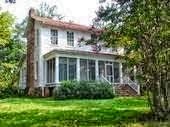
I guess this feeling of kinship with O’Connor is why I like to visit Andalusia Farm, just four miles from my teaching job at Georgia College and why I make a point of taking my students to the farm on field trips. I explain to them this kinship is why I often hiss, “Aren’t you ashamed?” when they forget to turn in their assignments.


- Doug Monroe, a former Atlanta journalist, teaches at Georgia College and lives in Milledgeville. He often volunteers at Andalusia Farm. 


Saturday, April 19, 2014

Pretty Historic


“It has been said that, at its best, preservation engages the past in a conversation with the present over a mutual concern for the future.” 
 -William Murtagh, first keeper of the National Register of Historic Places

An article about Andalusia was recently featured in the online magazine ArtsATL (http://www.artsatl.com/2014/04/director-elizabeth-wylie-grand-plans-andalusia-georgia-author-flannery-oconnors-home-historic-site/). The writer mentioned that a couple of rooms in the main house had been painted. In response a commenter posted “Two newly painted rooms? Part of the beauty of this house is the original paint on the walls from O'Connor's tenure there. I pray to god that this new director doesn't destroy the character and authenticity of this cultural treasure in an attempt to pretty it up!” Rest assured dear reader, everything we do at Andalusia is preservation wise and follows the principle of ‘do no harm’ appropriate to best practices for a National Register property. Yes, the rooms that were added to the house in 1950 as quarters for weekend visitors and were used as the ‘back parlor’ have been painted. This intervention can easily be reversed (we saved paint samples of the original gun-metal gray walls). In any event, an exact re-creation as we see it in historic photographs of the writer in the back parlor is not practically feasible. The over-sized book case that distinguished it in Flannery’s day is now ensconced, along with her books, desk, typewriter and other items, in the O’Connor Room at Georgia College where visitors are treated to an overview of Flannery as both a writer and a visual artist. At Andalusia, fresh colors in the back parlor signal for the visitor the threshold where historic interpretation of the house proper transitions to contemporary program space for lectures, exhibitions and media (how great would it be to show visitors the newsreel clip with a five year old Flannery and her backwards walking chicken!?). Having this flexible program space helps us advance our quest to extend the visitor experience of the site and has the added benefit of unburdening the 1850’s farm house dining room from program use. Long-time visitors to Andalusia will recall dining room lectures in which audience and speakers had to work around the existing (and original) furnishings. Indeed, we are fortunate to have so much of the original furnishings and architectural fabric of the main house. I very much look forward to the day when we can plan and implement a full restoration and interpretation of the home in which Flannery and her mother lived and in which one of our country’s most important writers produced an unparalleled literary oeuvre. Meanwhile, there are structures on-site that are literally falling down and the main house has to take its place in the queue. Our short-term strategy is two-fold: 1) immediate triage (do what we can now to stabilize threatened structures) and 2) deploy various means of engagement, both indoors and out, on the web and in print. On site we are activating the new program spaces, opening the Cow Barn and the Hill House, and paying attention to the vestigial garden beds and plantings to stimulate the conversation between the past and the present to consider the future. In so doing we hope to lay a foundation for ongoing and sustained support. Let’s call it a muster. Are you with us?

- Elizabeth Wylie, Executive Director
The Flannery O'Connor-Andalusia Foundation


Friday, April 11, 2014

Nature!


The violets in the mountains have broken the rocks.
- Tennessee Williams

I used to work in downtown Boston, all bricks, stone, concrete and glass. The view out my 7th floor office window was more bricks, stone, concrete and glass, and yes a bridge and the sky and if I craned my neck...Boston Harbor. What seemed like the same old starlings hung out on the fire escape just outside my window. One day I looked out at the very moment a hawk flew down and grabbed a bird and in a flurry of feet and feathers, off they went, bird and prey. This scene of course happens daily but the urban setting somehow drew a big line for me around 'nature' as opposed to man's constructed city. It was a poetic reminder that nature is surprising and beautiful and strong and trumps anything we might fancy as solid or permanent. Last week in Middle Georgia, nature was kicking up a storm when it crashed a branch down upon the already crumbling roof of the Equipment Shed; so much for our solid man-made structures! The need for a super emergency rescue kicked up a rush to action. A volunteer crew of men and women with modern machines has stepped forward and will be lifting and moving the fallen structure to save what's beneath the branches and the roof and the tumbles of plows, and rakes, tools and machines. We will move what is within to safe housing so it can be documented and sorted through and eventually brought back out to inform the visitor experience here at the farm. My own experience here is unfolding. While still cold and the snakes were nestled down, I spent considerable time exploring all the structures on the property. Some newly restored and awaiting programming, some already taken by nature, some in process, and some with a glimmer of vitality that can be revived. On my day off yesterday, I took a two hour ramble to learn more about the landscape. I saw lizards and chipmunks and birds of course. I saw the confident tracks of a huge tom turkey (possibly the same one seen preening and posing in the early mornings as I drive in) and the quiet tracks of a stealth bobcat, paw prints soft and gentle in the mud. Still, I was mindful of snakes (we are home to rattlesnakes and copperheads and lovely rat snakes and such) and I imagined the creatures, after seeing the human tracks, being mindful as well. When I got to one of the highest points and looked out above the trees, I saw a hawk swooping and dipping and thought " I love this place!" and reveled in the counterpoint memory of nature unfolding on the fire escape in the dense city center.

- Elizabeth Wylie, Executive Director
The Flannery O'Connor-Andalusia Foundation


Friday, April 4, 2014

Love the one you're with


“Accepting oneself does not preclude an attempt to become better.”
Flannery O'Connor


As Andalusia enters organizational adolescence, it is a good time to take stock of whence we were born, where we have been, where we are, and where we are going. The Andalusia Foundation was established in 2001 and the property was opened to the public shortly thereafter. At 13 years old, our coming of age story, or bildungsroman as it is known in literary criticism, can be seen as a tale of vision and hard work and the support of so many individuals, foundations and government funders. To help us in our rite of passage, we are fortunate to have been awarded a MAP grant. MAP is an acronym for Museum Assessment Program and is supported through a cooperative agreement between the Institute of Museum and Library Services and the American Alliance of Museums. The grant is not cash but expertise and provides guidance in meeting priorities and goals and understanding how our museum compares to standards and best practices. Since 1981, the program has helped over 4,300 museums maintain and improve operations through a confidential, consultative process. From now until early July our internal MAP team (staff, board members and other stakeholders) will be engaged in a guided self-study, a kind of self-acceptance exercise. This work will set the stage for a site visit by a peer reviewer later in the summer. The reviewer's report will suggest some action steps, frame strategic planning, and will offer us a view of the road to our next stage of growth. Stay tuned as we learn more about ourselves and chart a course for post-adolescence.

- Elizabeth Wylie, Executive Director
The Flannery O'Connor-Andalusia Foundation


Saturday, March 29, 2014

A Warm Welcome


“The things we see, hear, smell and touch affect us long before we believe anything at all.” ~Flannery O’Connor

I must have been about eight years old the first time I was made ‘aware’ of Flannery O’Connor. My stepfather would on occasion wear a T-shirt that bore the illustration of a rather peculiar looking woman holding a Bible, with a peacock’s plumage in full regalia unfurled behind her.

It was not until many years later that I was finally given context for the odd looking woman that had been emblazoned across my stepfather’s chest. I acquired a copy of Noonday’s 1966 edition of Everything That Rises Must Converge from the used section of a bookstore – the “old book smell,” a mixture of musk and grass, permeated the yellowed pages. By the second page, I was in love. The spine of the book has since been reinforced with shipping tape, and the coffee and tea stains throughout are evidence not only my own clumsiness, but the many hours I have spent ruminating on O’Connor’s words – her profundity, her humor.

My appreciation of O’Connor’s writings, along with my love of the Georgia Piedmont in which I was raised, has fortuitously coalesced – and it is with great joy that I take on the role of Operations & Visitors Services here at Andalusia. While I have been in Milledgeville for just over two weeks, I am so appreciative of the warm welcome with which Andalusia, and my new home have received me. I am elated at the opportunity to work with such a laudable organization – and I look forward to the many collaborations, and friendships, that Andalusia has already proven to bear.

If you have an interest in volunteering or collaborating with us, feel free to contact me at wiseblood@andalusiafarm.org – or find us on Facebook at https://www.facebook.com/Andalusiafarmpage, along with our volunteer group at https://www.facebook.com/groups/AndalusiaFarmVolunteers/. I look forward to hearing from you!

April Moon, Operations & Visitor Services Manager
The Flannery O’Connor – Andalusia Foundation

Friday, March 21, 2014

Backyard redux


 "From the beginning, relations between these birds and my mother were strained."
- Flannery O'Connor

One of wonderful things about museum work is the idea of preservation. Preservation is like a thread that sews together past and future. Preservation can engage people in sentimental remembrance of things past (yes, like Proust and his Madeleine) but also introduces others to new things or activities that can still have relevance today but have been lost in a tide of time. For me, the exciting part of my work here at Andalusia is remembrance and discovery of life ways that were part and parcel of life on a Middle Georgia dairy farm during the 1950s and early 1960s, the “period of significance” (that is preservation-speak for the time period we are focused on interpreting here). The frayed fabric of the farm is complex and I (a city girl!) am only beginning to wrap my brain around the functional layout of the farm, the realities of twice a day milking, and the ghost-like meaning behind the vestigial fence rows, abandoned equipment, and the various gates and enclosures. What has been especially gratifying this week has been bringing the backyard back to life. It all started with removal of a volunteer water oak. This tree must have been 40 feet tall and its branches were overhanging the house and providing access by all sorts of creatures to the warmth of the upstairs rooms. The root system was threatening the structure of the Main House and the rough and tangled roots were tearing up the paved carport/patio and were not for the faint of heart to traverse on the way to the back door. Now that the tree is gone and the healing process has begun, we can start to envision the backyard as it was. We have some indication in historical photographs showing the backyard with trimmed shrubs, edged beds and of course peacocks fanning their tails. In her essay “The King of the Birds”, Flannery offers a vivid evocation of backyard life, with of course the spectacle of the peacocks doing their spring thing, but she also names specific roses (Lady Bankshire and Herbert Hoover) and even fig trees that were part of the gardens here. That is helpful information as we work to restore and reinvigorate the gardens that Flannery's mother had to go to great pains to protect from the ravages of the free-range peafowl. Now living in an aviary, the peafowl are no longer a threat and we can begin to get the gardens in shape and can enjoy some of the heirloom roses and fruits and vegetables that were once grown here. Flannery's essay also reflects long term and keen observation of the peafowl, an activity that surely took place largely outdoors. Outdoors? Today that is somewhat anathema to 21st century lifestyles that take place largely indoors and involve screens of all sizes (big to little: smart phones, tablets, laptops, desktops, and televisions). Being outdoors is indeed a life way and is something we are preserving here. Yesterday we placed in the yard two period garden chairs and a table (given to us by a generous donor right out of her backyard!). Today, a group made immediate use by ‘visiting’. Beautiful!


- Elizabeth Wylie, Executive Director
The Flannery O'Connor-Andalusia Foundation